Consistency Beats Intensity, Especially After You Miss a Day
Streaks make consistency feel fragile. Effort curves make it feel forgivable. A look at why showing up moderately and often beats going all-in and burning out.
A streak is a strange kind of motivator. For a while, it works beautifully - each consecutive day adds to a number you don't want to lose, and that number pulls you out of bed even on days you'd otherwise skip. Then, inevitably, you miss one. Travel, illness, a genuinely bad week. And for a lot of people, that single miss doesn't just cost one day. It costs the whole habit, because the streak resets to zero and the thing that was motivating suddenly feels like proof you failed.
The Streak's Hidden Cost
The problem with a pure streak isn't the counting - it's the binary framing underneath it, on its own. Every day is either a perfect success or a total reset, with nothing in between. That works fine as long as you never miss. It works badly the moment you do, because the same number that made day 40 feel great makes day 41-after-a-miss feel like starting over from nothing, even though you have forty days of real evidence that you're the kind of person who does this.
Why day 41 feels like day zero
This is why streaks so often produce an all-or-nothing spiral: one missed workout turns into a skipped week, because psychologically the "damage" already felt done. The all-or-nothing framing, not the missed day itself, is what derails the habit. The streak count itself isn't lying - forty days really did end - but a single number with no memory of the forty days behind it is a thin way to represent months of real effort.
Pairing the Streak With a Longer View
A streak alone answers one question: is the chain unbroken right now. It's a fine question, but it's not the only one worth asking, and treated as the only signal, it turns every miss into a cliff edge. A useful complement is a rolling view - a sense of how consistent you've been over, say, the last thirty or ninety days, that dips when you miss and recovers when you resume, sitting alongside the streak rather than replacing it.
What a rolling view adds
One missed day barely moves a ninety-day view. A missed week moves it more, proportionally, which is accurate - a week off does matter more than a day - but it never erases the weeks of effort that came before it. The streak still tells you the chain broke; the longer view tells you what that break actually costs against everything else you've done. Seeing both together changes what a miss means. Looked at alone, a broken streak is catastrophic and total. Looked at next to ninety days of context, it's a small, honest dip in an otherwise solid record. The second framing isn't a replacement for the first - it's what keeps the first one from being the entire story.
Why Forgiving Misses Produces Better Long-Term Behavior
It might seem like the strict, no-excuses version of consistency would produce better outcomes - more pressure, more discipline, better results. In practice, habit-formation research generally points the other way: rigid, all-or-nothing systems tend to produce shorter-lived habits, because they can't absorb the ordinary disruptions of a real life - travel, illness, a demanding week at work - without the whole system feeling broken.
A system that expects occasional misses, and treats them as normal rather than disqualifying, tends to survive longer simply because it's built for how humans actually behave rather than how they behave in an idealized best case. Consistency, in other words, isn't the absence of missed days. It's a pattern that includes some missed days and keeps going anyway.
Intensity Has a Different Failure Mode
Intensity fails differently but just as reliably. An intense push - two-hour workouts, an ambitious new routine attempted at full strength from day one - produces fast, visible results, which is exactly what makes it appealing. It also tends to produce burnout on roughly the same timeline, because the initial motivation that made the intensity sustainable for a week or two doesn't hold up once the routine collides with an ordinary busy day.
Moderate, repeatable effort is less impressive in any single week. Compounded over months, it reliably outperforms the intense version, mostly because it's still happening in month three, when the intense version has usually already stopped.
Designing Around Forgiveness, Not Just Frequency
A few concrete things follow from treating consistency as a pattern viewed over weeks, not just an unbroken chain:
- Make the minimum version genuinely small. If the baseline requires real effort every single day, misses will be frequent and each one will sting more.
- Look at trend, not the single worst day. A view that's been climbing for two months and dipped once yesterday is a different situation than one that's been declining for two months and happened to be fine yesterday.
- Resume immediately, don't wait for a clean start. The instinct after a miss is to wait for Monday, or the first of the month, to "restart properly." That wait is usually where the habit actually dies - the next opportunity to do the thing is the right time to resume it, not some symbolically cleaner one.
Where this shows up in practice
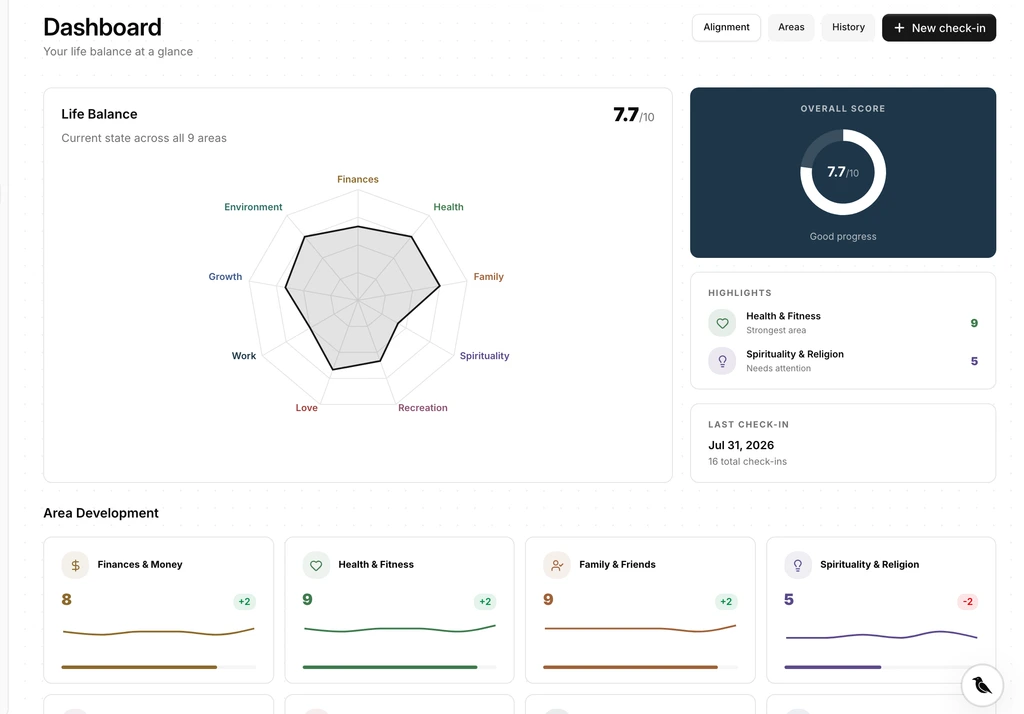
Aliigned's life areas do this deliberately: each habit still keeps a real streak counter - including a warning when a streak is about to end that night - so the chain itself is never hidden or softened. But sitting next to it is a 90-day consistency grid and a rolling effort score, so a broken streak doesn't stand alone as the only number on screen. The zero is real when a streak breaks; it just isn't the whole picture anymore.
The Boring Version Wins
None of this is a dramatic insight - showing up at 70% for a year beats showing up at 100% for three weeks. But it's easy to forget when a streak counter is the only thing in front of you, quietly implying that anything less than perfect resets to nothing. The streak isn't wrong to track - it's just not sufficient on its own. The more useful habit is checking it alongside the longer view: not just "did I keep the streak," but "is the trend still pointed the right way." Most weeks, even imperfect ones, the honest answer to the second question is yes.
Related blogs
Related Post
Expand your knowledge with these hand-picked posts.

The Two-Minute Morning Check-In Beats the Perfect One
A tiny, repeatable morning ritual outlasts an elaborate one. Here is why two honest minutes each morning do more for your day than a routine you eventually abandon.
Maya K.

Monthly Goal Reviews That Actually Stick
A monthly review only works if you seal it and score yourself honestly. Here is a simple structure for reviewing goals without turning it into another task you dread.
Owen R.

Life Areas: A Map for Where Your Attention Actually Goes
Burnout rarely arrives as a single crisis. It usually starts as one life area quietly starved of attention for months. A simple map can catch that early.
Priya S.
Run your life from one calm place.
Free to start. Two minutes tomorrow morning.