Journaling: What the Research Actually Suggests
A hedged look at what expressive-writing and reflection research suggests about journaling - what seems to hold up, what is overstated, and what nobody has really shown.

Journaling has a reputation as an obviously good habit, the kind of advice that shows up on every wellness list next to drinking more water and sleeping eight hours. That reputation is largely deserved, but it's worth being precise about what the underlying research actually supports, because "journaling is good for you" covers a wide range of claims, some much better supported than others.
The Core Finding, Stated Carefully
The best-known thread of research in this area is generally described as expressive writing - writing about emotionally significant experiences, often difficult ones, for a short period over a few consecutive days. Studies in this tradition, going back several decades, suggest that this kind of writing is associated with modest improvements in measures like mood and reported well-being, and in some studies, physical health markers, compared to writing about neutral, unemotional topics.
It's worth being precise about the hedges here. "Associated with" is doing real work in that sentence - much of this research is correlational or based on short-term interventions, not long-run causal proof that journaling changes your life trajectory. The effect sizes reported across studies vary and are often modest, not the dramatic transformation the wellness-list version of this advice implies. And meaningfully, not every study replicates cleanly, which is common across most of behavioral science, and a reason to treat any single study - or any single blog post, including this one - with some skepticism.
What Seems to Actually Be Happening
Setting aside the specific numbers, researchers in this space generally offer a few candidate explanations for why writing about a difficult experience seems to help, and none of them require the writing to be elaborate or long:
Naming reduces the size of the thing
A vague, unnamed worry tends to feel larger and more diffuse than the same worry once it's written down in a sentence. Putting language around an experience appears to make it more specific and bounded, which several researchers in this area suggest may reduce its emotional weight, though the mechanism isn't fully settled.
Processing versus ruminating
There's a meaningful difference, this research suggests, between writing that processes an experience - looking at it, making some sense of it, moving past it - and writing that just rehearses the same distress repeatedly without new insight. The former appears more strongly associated with benefit; the latter, sometimes called rumination, is generally associated with worse outcomes. This distinction matters more than the simple advice "journaling helps" usually conveys - the how may matter as much as the whether.
A record you can compare against
Separate from the expressive-writing literature, there's a simpler, more mechanical benefit that doesn't require any particular emotional depth: a written record lets you compare how you actually felt two months ago to how you remember feeling, and those two things are often surprisingly different. Human memory reconstructs the past to fit the present mood - a bad week can retroactively make a fine month feel worse in memory than it was at the time. A contemporaneous log is one of the few tools that can catch that gap.
Where the Evidence Gets Thinner
A few common journaling claims are more folklore than finding, and it's worth naming them as such rather than borrowing their credibility from the expressive-writing research they get lumped in with:
- That gratitude journaling specifically outperforms other reflection formats. Some research supports a mood benefit from gratitude-focused writing, but claims that it's meaningfully superior to other reflective formats are weaker and less consistent than popular treatments suggest.
- That daily journaling is required, or that more is always better. Much of the classic expressive-writing research used short bursts over just a few days, not indefinite daily practice - the "you must do this every day forever" framing is an extrapolation, not a finding.
- That journaling functions as a substitute for professional support with serious mental health conditions. The research generally describes a wellness-adjacent practice with modest effects, not a clinical intervention, and it isn't positioned as one in the literature it comes from.
A Reasonable, Hedged Takeaway
Put cautiously: writing briefly and honestly about what's actually happening in your life, including the difficult parts, appears to be associated with modest but real benefits for mood and self-understanding, most plausibly through naming and processing rather than sheer accumulation of pages. It doesn't need to be long, doesn't need to happen every single day without exception, and isn't a substitute for other kinds of support when something serious is going on.
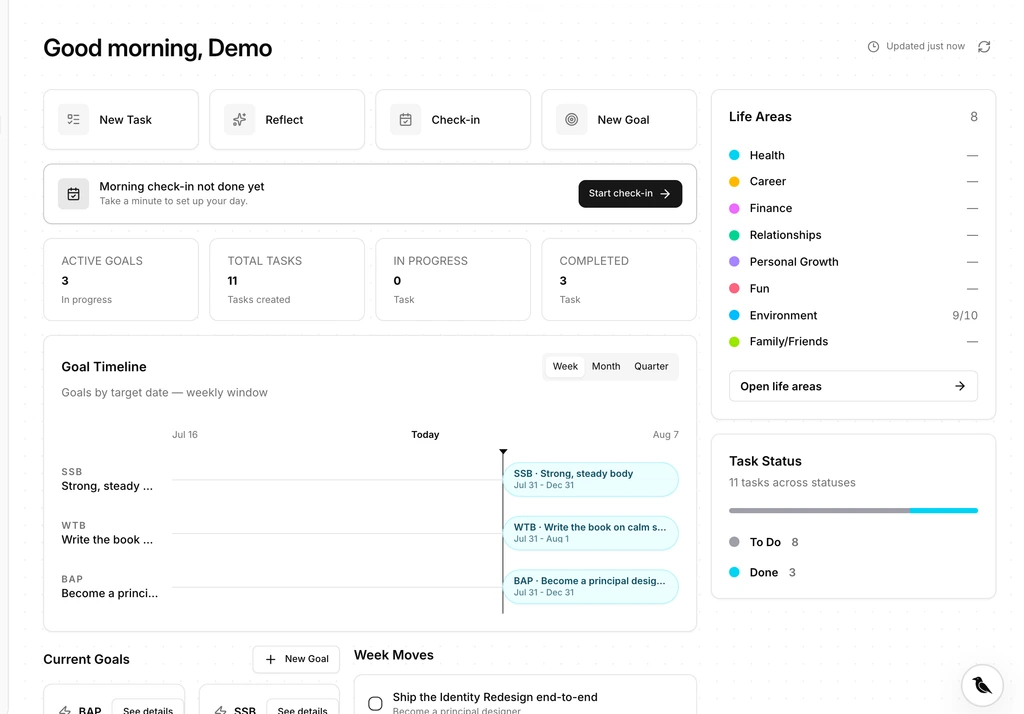
This is roughly the bet behind a tool like Aliigned's daily check-ins - short, low-friction, honest entries rather than long-form journaling, on the theory that the modest, well-supported version of this benefit comes more reliably from something you'll actually keep doing than from an ambitious format you'll do for two weeks and then not again.
What Would Change This View
If you want to hold this lightly, as the evidence suggests you should: watch for research that more directly tests long-run causal effects rather than short interventions, that separates processing from rumination more rigorously, and that's honest about effect sizes rather than rounding a modest finding up to a dramatic one. Until then, the reasonable version of "journaling helps" is a real but modest claim, not a guarantee - which, if anything, is a good match for a habit that works best kept small.
Related blogs
Related Post
Expand your knowledge with these hand-picked posts.

The Two-Minute Morning Check-In Beats the Perfect One
A tiny, repeatable morning ritual outlasts an elaborate one. Here is why two honest minutes each morning do more for your day than a routine you eventually abandon.
Maya K.
Monthly Goal Reviews That Actually Stick
A monthly review only works if you seal it and score yourself honestly. Here is a simple structure for reviewing goals without turning it into another task you dread.
Owen R.
Life Areas: A Map for Where Your Attention Actually Goes
Burnout rarely arrives as a single crisis. It usually starts as one life area quietly starved of attention for months. A simple map can catch that early.
Priya S.
Run your life from one calm place.
Free to start. Two minutes tomorrow morning.